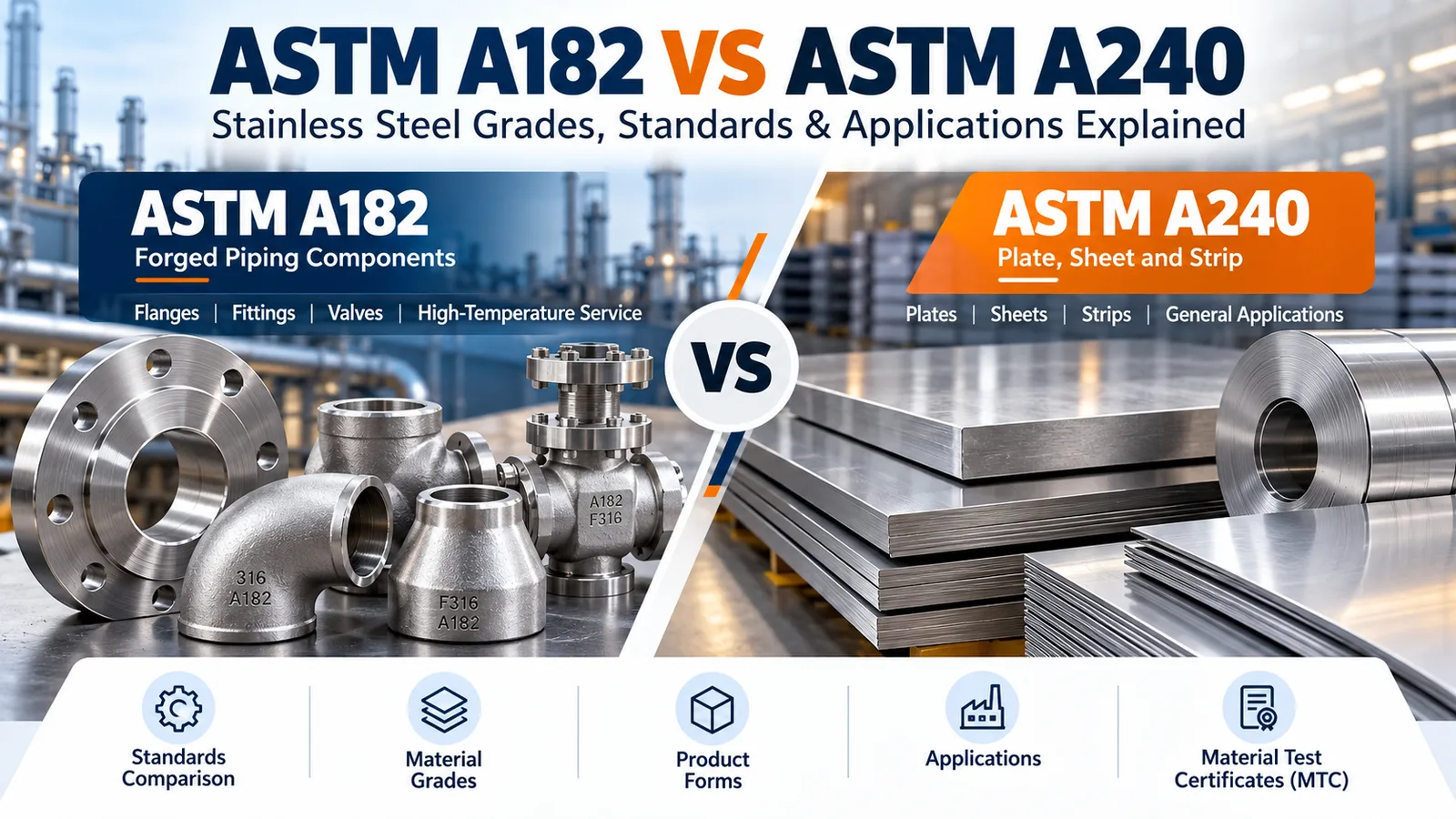
Two stainless steel orders can both say "316L" and still be completely different products. One is a forged flange, the other is a plate, and the standard behind each is different. Mixing up ASTM A182 vs A240 is one of the most common reasons for wrong quotes, rejected material and delayed dispatch. This guide explains what each standard covers, how the grades differ, and what to check before you order.
ASTM A182 vs A240 in one line
ASTM A182 covers forged or rolled alloy and stainless steel pipe flanges, forged fittings, valves and parts for high-temperature service. ASTM A240 covers chromium and chromium-nickel stainless steel plate, sheet and strip for pressure vessels and general applications.
Same family of steel, different product forms, different requirements.
What is ASTM A182?
ASTM A182/A182M is the specification for forged or rolled alloy and stainless steel piping components. If you are buying flanges, forged fittings or valve bodies, this is usually the standard on the order.
Common stainless grades under A182:
- F304 / F304L: austenitic grades for general corrosion resistance
- F316 / F316L: molybdenum-bearing grades with better resistance in many corrosive environments
- F321: stabilized grade for selected elevated-temperature service
- F51 (duplex): higher strength and improved resistance to chloride stress corrosion cracking
The "F" prefix tells you the grade is a forged designation. It is not just a naming habit.
What is ASTM A240?
ASTM A240/A240M is the specification for flat-rolled stainless steel. It is the standard behind the plate and sheet that fabricators cut, form and weld into finished equipment.
Common grades under A240:
- 304 / 304L: the everyday choice for fabrication, equipment and general industrial use
- 316 / 316L: selected where better corrosion resistance is needed
- 321: used where resistance to certain forms of intergranular corrosion matters
- 2205 (duplex): high strength with good corrosion resistance for demanding environments
Typical end uses are tanks, vessels, enclosures, process equipment, panels and fabricated components.
Key differences at a glance
| Feature | ASTM A182 | ASTM A240 |
|---|---|---|
| Product forms | Forged or rolled piping components | Plate, sheet and strip |
| Typical items | Flanges, forged fittings, valves | Tanks, vessels, panels, fabricated parts |
| Grade naming | F304, F304L, F316L, F51 | 304, 304L, 316L, 2205 |
| Governing focus | Pressure-containing component requirements | Flat-product and fabrication requirements |
| Usually checked with | Dimensional standard (ASME B16.5, B16.11) and heat number | Thickness, size, finish and heat number |
Important: matching grade numbers do not make two products interchangeable. Product form, manufacturing route, mechanical properties, heat treatment, dimensions and the project specification all matter.
What about pipes, bars and butt-weld fittings?
These are covered by other ASTM standards, which is another reason to never order by grade alone:
- Pipes and tubes: for example ASTM A312 (seamless and welded austenitic pipe)
- Butt-weld fittings: for example ASTM A403
- Bars: for example ASTM A276
Always confirm the full specification, not only "316L" or "304".
Which standard do you need?
- Buying flanges, forged fittings or valves? Look at ASTM A182.
- Buying plate, sheet or strip for fabrication? Look at ASTM A240.
- Buying pipe, fittings or bar? Check the pipe, fitting or bar standard named in your project specification.
- Unsure? Ask your engineer or EPC contractor for the exact material specification before requesting quotes.
Documents to check before accepting material
Whichever standard applies, buyers usually expect a proper certificate with the order:
- Material specification, grade and edition
- Heat number matching the material marking, see heat number traceability
- Chemical composition and mechanical test results
- Heat treatment details
- Required tests, for example PMI or intergranular corrosion tests
- Certificate type, most commonly EN 10204 3.1, see EN 10204 3.1 vs 3.2
Common purchasing mistakes
- Ordering by grade name alone, without the ASTM specification.
- Treating forged flanges and plate as the same product.
- Ignoring thickness, dimensions, pressure class or service conditions.
- Accepting certificates without checking heat numbers.
- Assuming similar stainless grades can be swapped freely.
- Not stating the required certificate type on the purchase order.
A clear purchase specification prevents delays, documentation problems and costly mismatches.
Make your certificates match your material
Even the right material can be held up by an incomplete certificate. Copying heat numbers and test values by hand from old Word or Excel files is where errors creep in.
MTCMitra helps metal companies create EN 10204 3.1 certificates from ready templates. Heat numbers, chemistry, mechanical values and test results are entered once and printed correctly in a professional, branded format. Read more in MTCMitra: mill test certificate software for metal companies.
Frequently asked questions
Is ASTM A182 the same as ASTM A240?
No. A182 covers forged or rolled piping components such as flanges and fittings. A240 covers plate, sheet and strip.
Is 316L the same as F316L?
They belong to the same chemistry family, but 316L is the plate and sheet designation under A240 and F316L is the forged designation under A182. Requirements, testing and documentation differ.
Can I make flanges from A240 plate?
Only where the applicable code and project specification allow it. Do not assume plate can replace forged material. Check with your engineer before substituting.
Which standard is used for stainless steel pipe?
Pipe is covered by separate standards, such as ASTM A312 for austenitic stainless pipe. A182 and A240 do not apply to pipe.
What should I ask my supplier for?
Request the full ASTM specification and edition, grade, dimensions and a certificate with heat number traceability. Add any inspection or third-party requirements to the purchase order.
Key takeaways
- A182 is for forged or rolled piping components. A240 is for plate, sheet and strip.
- Grade names look similar, but the products are not interchangeable.
- Pipes, butt-weld fittings and bars have their own standards.
- Always order with the full specification, not just the grade.
- Check heat numbers and certificates before accepting material.
Choosing the right standard at the start is the easiest way to avoid rejection at the end.
Disclaimer: This article is for general information only. Always refer to the applicable ASTM standard, project specification and qualified engineering guidance for material selection and compliance.